It’s not only getting a van and then converting it – it is important to get the paperwork side of things right as well. In this article I’ll take you through the legal side of your campervan journey.
What is a camper van?
There are so many rumours out there about the legal aspects of camper van conversions that it’s quite difficult to know which advice is right and which is not. I’d like to clear up a bit of this mess and hope to give you a good understanding of what is involved in getting a vehicle road legal as a campervan.
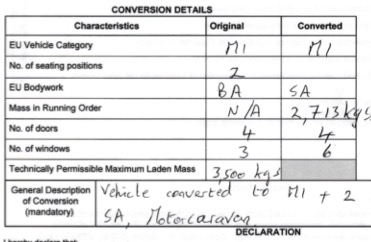
So first things first: At the end of a conversion process your previously commercial van will be a Motor Caravan in the EU Vehicle Category M1 with EU Body Type SA Motorcaravan.
To qualify as a camper van, the van must have:
- Seats and a table
- sleeping accommodation (which may be converted from the seats)
- cooking facilities (Hob and Sink)
- storage facilities
- minimum one side window
Furthermore revenue states that:
This equipment must be securely fitted to the living compartment. Tables that can be removed easily are acceptable.
Primarily a motor caravan should provide mobile living accommodation where a person (of average height) can move around comfortably while standing.
The living accommodation area should allow for a comfortable living environment for a person, or persons, for an extended period.
How do we get there?
After we here at Unfollow Campervans have finished the conversion works on your camper van there is usually three very important certifications – we will provide you with them.
First is the electrical certification, each Unfollow Camper having a 230V installation (similar to the electrics in your house) the electrician (Registered Electrical Contractor (REC)) who installed everything will issue a Completion Certificate according to the Electricity Regulation Act 1999.
Then there is the gas installation. Here we work closely with a RGI (Registered Gas Installer) who will, after the gas installation is finished, thoroughly test everything and once everything is safe and according to standards he will issue a DOMESTIC PREMISES GAS INSTALLATION
DECLARATION OF CONFORMANCE FOR NEW INSTALLATIONS.
With those to certificates issued we’ll then go to our automotive engineer (also referred to as SQI – suitably. qualified individual) which inspects that all the works are carried out according to standard and then issues the main certificate: the DECLARATION OF CONVERSION OF A VEHICLE.
Now we’re almost there…
…but there are two more things to be done:
First, we need to put all the needed documentation into a file, we from Unfollow Camper Vans help you with that. The declaration from the SQI, the revenue checklist, the invoices as proof of cost of conversion and a set of photos. We’ll compile all of that into a pdf file which you’ll need for the last step:
VRT – Vehicle Registration Tax
Now that’s the big unknown, unfortunately. Once we have sent you the pdf document about your camper van you’ll have to send it to revenue in Wexford, and they then will take their time, usually anywhere between 2 weeks and sometimes 2 months, and then estimate the Open Market Selling Price (OMSP) at the time of registration – the big unknown. To the best of my knowledge the OMSP is based on the age and mileage of the vehicle AND the cost of the camper conversion. So once they have done their black magic they’ll get back to you with a figure, 13.3% of the OMSP together with their bank details. When they have received your VRT payment then
YOU FINALLY HAVE YOUR CAMPER VAN 🙂
With the VRT confirmation you can then go ahead and tax and insure your vehicle as a camper van.
Good News: We from Unfollow help you throughout this whole process the best we can, after all we’ve done it so many times.
More Good News: The new road tax for your camper is only e102 per year – and the insurance is much cheaper then a car insurance as well!